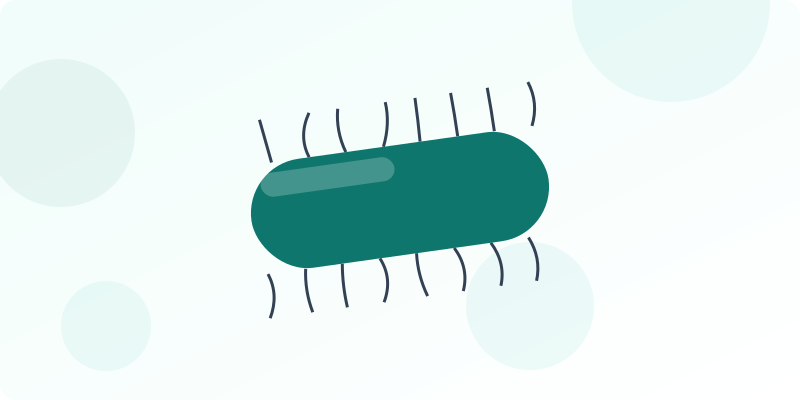
Many bacterial adhesins sit at the tip of a rigid stalk and simply hold on. Type IV pili are different. These long, thin filaments can grow outward, stick to a surface and then shrink back into the cell, pulling the bacterium forward. Repeated cycles of extension and retraction produce a jerky form of movement known as twitching motility.
Type IV pili are found across a wide range of Gram-negative bacteria, including Pseudomonas aeruginosa, Neisseria species and Vibrio cholerae, and related systems occur in some Gram-positive bacteria and archaea. They are among the most versatile surface structures in microbiology.
What a Type IV Pilus Is Made Of
The filament is a helical polymer built mainly from thousands of copies of a small protein called pilin (often named PilA or PilE depending on the species). Each pilin has a hydrophobic N-terminal helix that packs into the core of the filament, while the rest of the protein faces outward and forms the surface that contacts the environment.
Pilins are made with a short leader sequence that is removed by a dedicated enzyme, the prepilin peptidase, before assembly. Minor pilins, present in much smaller amounts, help start assembly and can carry specialized adhesive functions.
The assembly machine
A multi-protein machine spans the cell envelope. Key parts include:
- An inner membrane platform protein that links the motors to the growing filament.
- An extension ATPase (commonly PilB) that uses ATP to add pilin subunits to the base of the pilus.
- A retraction ATPase (commonly PilT) that removes subunits, pulling the filament back in.
- An outer membrane channel called the secretin, through which the pilus exits the cell.
How Twitching Motility Works
Twitching follows a simple cycle. The pilus extends, its tip binds a surface or another cell, and then the retraction motor depolymerizes the filament from the base. Because the tip is anchored, retraction drags the cell toward the attachment point. The pilus then releases, and the cycle repeats.
Retraction motors in type IV pili are known to generate remarkably strong pulling forces for their size, which is part of why these systems are of interest to biophysicists. Because many pili act at once and in different directions, movement looks irregular under the microscope, hence the name "twitching."
Roles in Adhesion and Colonization
Type IV pili are important early adhesins. They let bacteria make initial contact with host cells or abiotic surfaces at a distance, before tighter binding by other adhesins. In Neisseria, for example, type IV pili mediate the first attachment to mucosal cells. In Vibrio cholerae, a type IV pilus called the toxin-coregulated pilus helps bacteria form microcolonies in the intestine.
Retraction also seems to help bacteria sense that they have touched a surface. Resistance to pilus retraction can act as a mechanical signal that triggers changes in gene expression, a process often described as surface sensing.
Type IV Pili in Biofilms
In Pseudomonas aeruginosa, twitching motility helps cells spread across a surface and organize into the clustered structures typical of mature biofilms. Strains lacking functional pili often form flatter, less structured biofilms in laboratory models. For more on how biofilms develop, see our article on biofilm formation and surface colonization.
Other Functions
Type IV pili do more than move and adhere:
- DNA uptake: in naturally competent bacteria, pili or closely related structures help capture DNA from the environment, contributing to natural transformation.
- Phage receptors: some bacteriophages use type IV pili as their entry point, attaching to the filament and riding retraction toward the cell.
- Electron transfer: in some environmental bacteria such as Geobacter, pilus-like filaments have been studied for their role in transferring electrons to minerals.
Relevance to Infection Research
Because type IV pili are needed for colonization by several pathogens, they are studied as possible targets for vaccines and anti-adhesion approaches. Pilins are often highly variable on their exposed surfaces, however, which can help bacteria evade antibodies and complicates vaccine design. Our glossary defines related terms such as secretin and pilin.
Key Takeaways
- Type IV pili are dynamic filaments built from pilin subunits by a membrane-spanning machine.
- Opposing ATPase motors drive extension and retraction, producing twitching motility.
- They mediate early adhesion, surface sensing and biofilm organization.
- They also support DNA uptake and serve as phage receptors, making them a broad research focus.
Educational information only, not medical advice. Always follow the advice of a qualified healthcare professional about any infection or treatment; in an emergency call your local emergency number.